
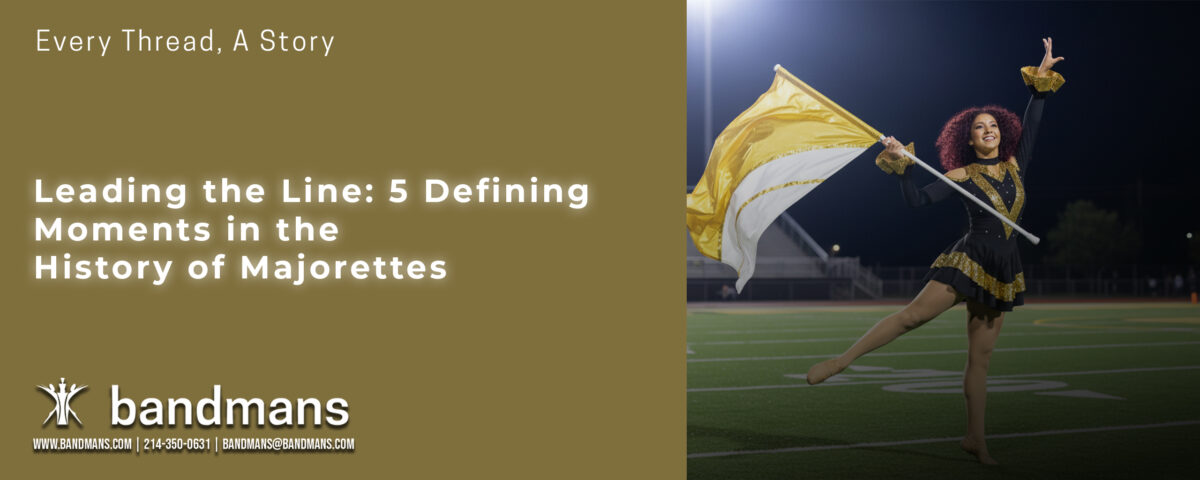
Leading the Line: 5 Defining Moments in the History of Majorettes
It is a role that demands a rare combination of skills: the command of a conductor, the athleticism of a gymnast, and the grace of a dancer. The majorette is one of the most enduring symbols of the marching arts, a figure who literally leads the band. Yet, the history of this position is a fascinating journey of transformation. What began as a rigid military function has evolved into a high-energy sport, blending technical precision with show-stopping artistry. Here are the five key chapters that shaped the dynamic legacy of the majorette.
Throughout the years, Majorettes have captured the hearts of many, showcasing their talents in various parades and competitions.
1. The European Roots: Swords and Torches
While the majorette is often viewed as an American icon, the roots of the craft dig deep into European history. The tradition can be traced back to the “Schützenfests” (marksmen’s festivals) of Germany and Switzerland. In these early parades, men known as “whifflers” would march at the front of the procession, tossing swords, rifles, or torches into the air to clear a path and entertain the crowds. This practice of rhythmic object manipulation laid the groundwork for baton twirling. It was a display of dexterity and danger, designed to command attention before the musicians even arrived.
The majorette is a vital part of the marching band, where Majorettes demonstrate their skills and artistry on the field.
2. The American Shift: From Drum Major to Majorettes
As marching bands became a staple of American culture in the post-Civil War era, the “drum major”—the leader responsible for keeping time and directing the band—was a strictly male, military role. However, the 1930s marked a pivotal shift in the visual landscape of the field. As bands sought to add more visual entertainment to their performances, women entered the field, adapting the heavy mace of the drum major into the lighter, more maneuverable metal baton.
This was the birth of the “drum majorette.” The change was not just gender-based; it was stylistic. The rigid, functional movements of the drum major were softened and sped up, introducing a level of fluidity and showmanship that had never been seen on the gridiron before.
Majorettes have played a crucial role in enhancing the visual appeal of performances, captivating audiences everywhere.
3. The Golden Age of Pageantry
The post-WWII era, particularly the 1940s and 50s, became the golden age for the majorette. As high school and collegiate football exploded in popularity, the demand for halftime spectacle skyrocketed. Organizations like the National Baton Twirling Association (NBTA) were formed, standardizing the sport and elevating it from simple marching accompaniment to a disciplined art form.
During this era, the uniform became iconic. The aesthetic was a deliberate blend of military authority and feminine power—shakos and epaulets borrowed from the soldiers, paired with skirts and boots that allowed for athletic movement. It was during this time that fire batons and hoop batons were introduced, raising the stakes and turning the majorette into a true stunt performer.
As the majorette evolved, the influence of Majorettes became increasingly significant in the world of competitive marching bands.
4. The HBCU Revolution: Rhythm and J-Setting
While traditional twirling focused on the baton, a parallel and powerful evolution was happening at Historically Black Colleges and Universities. In the late 1960s and 70s, legendary groups like the Alcorn State “Golden Girls” and Southern University’s “Dancing Dolls” revolutionized the concept of the majorette.
They introduced a style that was soulful, rhythmic, and fiercely precise. This gave birth to “J-Setting”—a style of dance characterized by sharp, synchronized movements, call-and-response choreography, and “stand battles” in the bleachers. In this tradition, the body itself became the instrument. The focus shifted from twirling an object to the collective movement of the line, influencing modern pop culture and dance teams worldwide.
The impact of Majorettes at HBCUs has inspired countless young performers to embrace this art form.
5. The Modern Sport: Athletics Meets Art
Today, the majorette line is more versatile than ever. The line between majorette, color guard, and dance team has blurred, creating a visual ensemble that utilizes flags, rifles, batons, and dance. Yet, the athletic demand is higher than ever. Modern competitive twirling is recognized as a sport, requiring the flexibility of a rhythmic gymnast and the endurance of a track runner. Whether performing a “finger twirl” or a “toss illusion,” the modern majorette must execute physics-defying tricks while marching in perfect step.
More Than a Uniform The legacy of the majorette is one of breaking barriers. It began as a way for women to enter a male-dominated space and evolved into a platform for athletic and artistic expression. It teaches confidence, poise, and leadership. When a majorette steps onto the field, she is not just performing; she is carrying a torch passed down through generations of performers who dared to lead the way.
In today’s contemporary performances, Majorettes continue to push the boundaries of art and athleticism.
With the rise of competitive events, Majorettes have now gained recognition as elite athletes in their own right.
The history of the majorette is a reminder that tradition is never static—it moves, it spins, and it evolves. From the heavy mace of the 1800s to the high-velocity spins of today’s championships, majorettes have consistently redefined what it means to lead. They prove that with enough practice and passion, you can quite literally turn the world around your fingers.
The journey of Majorettes reflects a rich tradition of resilience and creativity.
Perform with Confidence and Style At Bandmans Company, we honor the tradition of the majorette with uniforms that are as resilient as they are radiant. Whether you are looking for classic sequin aesthetics or modern, athletic cuts, we have the gear to help you shine.