
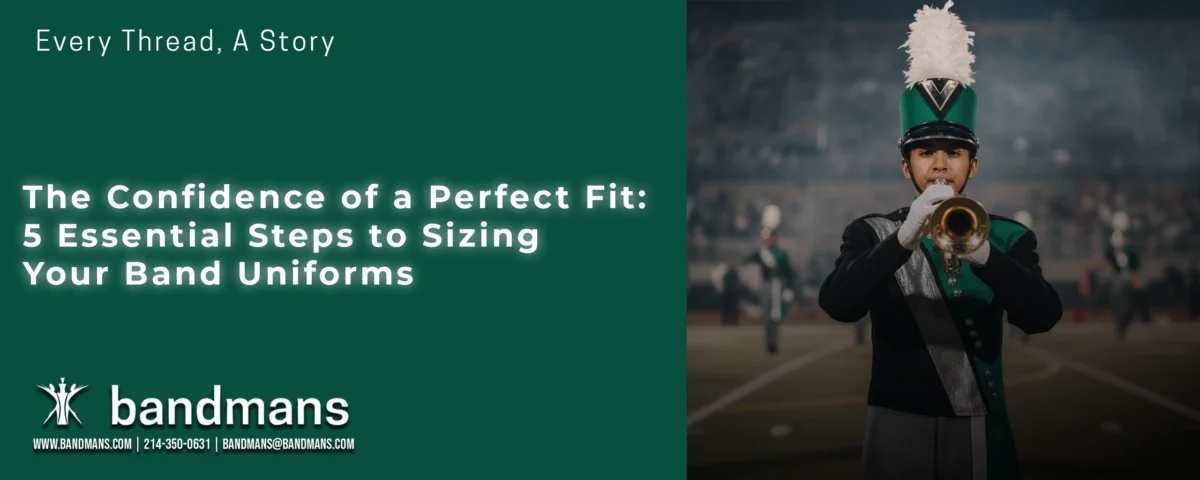
The Confidence of a Perfect Fit: 5 Essential Steps to Sizing Your Band Uniforms
There is a distinct psychology to putting on a uniform. When the jacket zips up and the shako is placed, the student transforms. They are no longer just a teenager; they are a performer, a representative of the school, and a guardian of tradition. However, that transformation relies heavily on one crucial, often overlooked detail: the fit. A properly fitted uniform is essential not just for aesthetics, but for the physical mechanics of marching and playing. When a student feels comfortable and unrestricted, they perform with greater precision and pride. By mastering the art of sizing your band uniforms, you ensure that every member of your ensemble looks sharp and moves with effortless confidence. Here are five essential steps to ensuring every member of your ensemble looks sharp and moves with effortless confidence.
1. Precision Measuring: The Foundation of the Look
The difference between a “costume” and a “uniform” is often found in the tailoring. To achieve a professional look, you must move beyond standard t-shirt sizes (S, M, L) and embrace specific measurements. Accurate sizing requires a flexible measuring tape and a disciplined approach. When sizing your band uniforms, accurate data collection requires a flexible measuring tape and a disciplined approach.
The Chest: Measure under the arms around the fullest part of the chest. This dictates the jacket size and ensures the musician has the lung expansion required for peak wind performance.
The Waist: Unlike street clothes, marching trousers (often bibbers) are worn higher. Measure the natural waistline, usually just above the navel, to ensure the garment hangs correctly without bunching.
The Inseam: This must be measured from the crotch seam to the desired length. Consistency here is vital; if one student’s pants break at the ankle and another’s drag on the ground, the visual uniformity of the line is broken.
2. Accounting for "Performance Room"
A marching band uniform is athletic gear disguised as formal wear. Students are not standing still; they are high-stepping, crabbing, and executing visuals that require extreme ranges of motion. Therefore, the process of sizing your band uniforms must account for the difference between static posture and active performance. You must leave room for the “instrument carriage.” When a musician raises a trumpet or trombone, their back and shoulders expand. We recommend measuring students while they are holding their “air instrument” to account for this necessary expansion. This ensures that the fabric moves with the musician, not against them.
3. The Visual "Break": Creating the Illusion of Height
One of the primary goals of a marching uniform is to make the performer look taller and more imposing. This illusion is achieved through the vertical line of the trousers. A critical factor in sizing your band uniforms is the “break”—where the pant leg meets the shoe. Ideally, the front of the pant leg should rest lightly on the shoe laces, creating a slight fold or “break,” while the back should fall just above the heel. If the pants are too short (“high waters”), it disrupts the vertical line and draws the eye downward, making the marcher appear shorter. If they are too long, they create a tripping hazard, which is a significant safety risk during high-velocity drill movements. Uniformity in hemming creates a clean, seamless visual across the entire field.
4. Future-Proofing: Managing Growth Spurts
Secondary school students are in a state of constant physical change. A freshman fitted in August may be two inches taller by the time championships arrive in November. To protect your investment, you must prioritize adjustability when sizing your band uniforms. Look for uniforms designed with “generous allowances” in the seams. Many modern bibbers come with adjustable snap systems at the shoulders, allowing for instant length changes without sewing. This adaptability extends the life of the uniform inventory, allowing you to re-assign pieces to different students year after year. When sizing, it is often wise to round up slightly for younger students, using temporary hem tape or snaps to manage the length, ensuring the uniform can grow alongside the musician.
5. The Comfort Factor: Fabric and Temperature
Finally, fit is a matter of thermal regulation. A uniform that is too tight traps body heat, which can be dangerous during early season rehearsals in August heat. Modern moisture-wicking fabrics require a bit of air circulation to function effectively, which is why sizing your band uniforms correctly is a matter of student health. Ensure that the collar is not constricting the neck—wind players need an open throat to produce a full tone. A collar that is too tight can restrict the airway and cause tension in the jaw. By prioritizing a breathable fit, you are directly investing in the stamina and safety of your performers, allowing them to focus entirely on the music rather than their discomfort.
Ultimately, a uniform is a symbol of unity. When every member is fitted correctly, individual differences fade away, and the ensemble emerges as a single, cohesive force. It communicates professionalism to the judges and instills a deep sense of dignity in the students. At Bandmans, we believe that when you fit the player, you free the performance. It’s about more than fabric; it’s about giving your students the freedom to be exceptional.
Experience the Perfect Fit
Don’t let poor sizing compromise your season. Bandmans Company offers expert sizing resources and adjustable uniform solutions designed for the modern marching athlete. Let us help you find the size of success.